

JapanStrike EA
MT4 · USDJPY
 by Robot Forex Pro
6-month gain
- Gain
- +88.51%
- Max DD
- 14.16%
- Tracked
- 533 d
A specialized algorithmic trading system designed for high-probability trades on the USDJPY pair using support and resistance on the M15 timeframe.

 by Happy Forex
EURJPY · GBPJPY · USDJPY · MetaTrader 4 · MetaTrader 5 · Trend-Following
Happy Japanese Market EA is a trading robot (EA) for MetaTrader 4 and MetaTrader 5 that trades EURJPY, GBPJPY, USDJPY, with a trend-following strategy. It's sold by Happy Forex. We don't run it on an account of ours yet, so this page shows no live results.
€315
One-time licence · sold by Happy Forex
Price read from the vendor’s page on 13 Sept 2026. Opens the vendor in a new tab.
Happy Japanese Market EA Review: +70% Win Rate - Is This For Real?Featured
Happy Japanese Market EA is a sophisticated algorithmic trading system that focuses exclusively on Japanese Yen currency pairs (USDJPY, EURJPY, GBPJPY) during optimal Asian market conditions. Unlike aggressive scalping systems, this EA prioritizes quality over quantity by scanning the market continuously to identify single, high-probability trading opportunities each day. The system employs a unique methodology that combines technical indicators with market timing to capitalize on the specific characteristics of the Tokyo trading session. With built-in news filtering through ForexFactory calendar integration and equity protection features, the EA is designed for traders seeking consistent, long-term growth rather than quick gains.
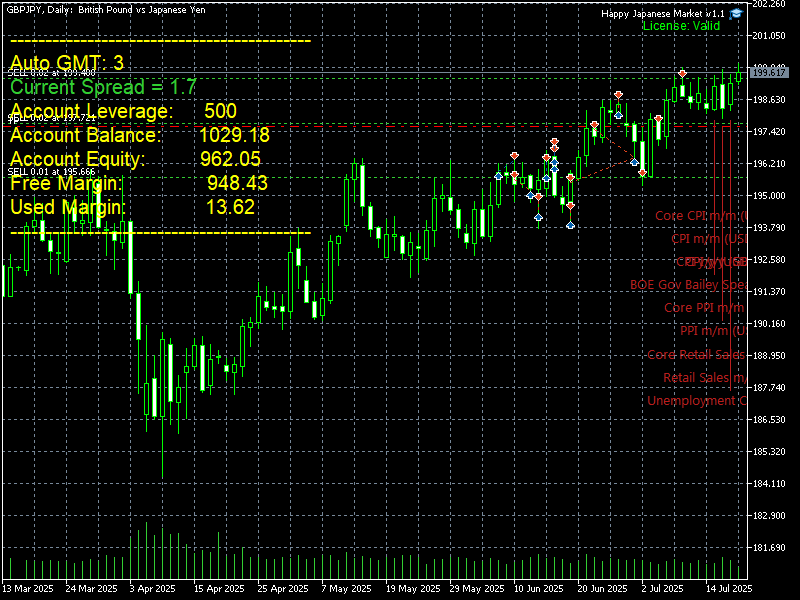
If you're seeking a conservative, long-term approach to automated forex trading with a focus on the Asian market, Happy Japanese Market EA offers a proven solution. This system is ideal for traders who prefer quality over quantity, with its emphasis on single daily trades and consistent growth rather than aggressive scalping strategies. The EA's specialized focus on Japanese Yen pairs, combined with its intelligent recovery system and built-in risk management features, makes it suitable for both beginning and experienced traders looking to diversify their automated trading portfolio.
The Happy Japanese Market EA combines proven technical analysis with intelligent market timing to deliver a comprehensive automated trading solution for Japanese Yen pairs.
Happy Japanese Market EA trades USD/JPY, EUR/JPY, and GBP/JPY, all monitored from a single chart installation.
Happy Japanese Market EA trades USD/JPY, EUR/JPY, and GBP/JPY, all monitored from a single chart installation. The strategy operates during Asian session hours, a window specifically chosen for its consistent ranging behavior on Yen pairs and the structured institutional activity that defines Tokyo market conditions.
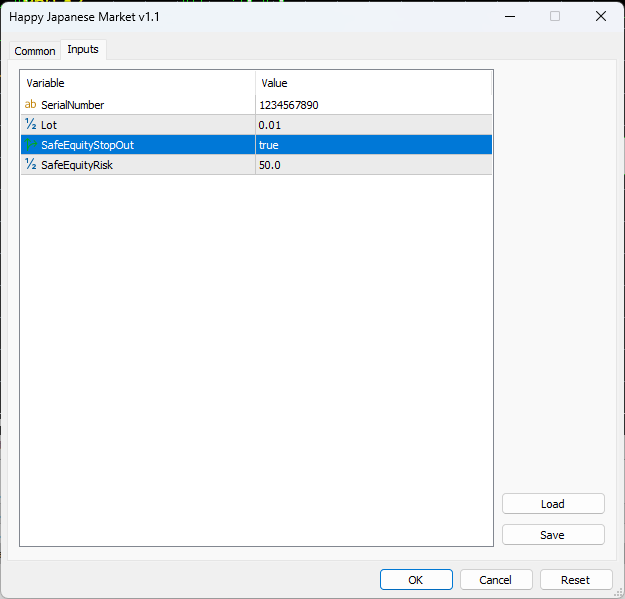
Position sizing is tied to account balance, with recommended lot configurations provided for different capital levels.
Position sizing is tied to account balance, with recommended lot configurations provided for different capital levels. A 15-trade maximum on recovery sequences prevents open exposure from extending without limit, while configurable risk parameters allow traders to set boundaries that reflect their individual drawdown tolerance and account size.
Once installed and running on a VPS, the EA handles every stage of the trade cycle without requiring manual input, from initial entry through recovery sequence management to final exit.
Once installed and running on a VPS, the EA handles every stage of the trade cycle without requiring manual input, from initial entry through recovery sequence management to final exit. Targeting the Asian session means the system operates primarily during overnight hours for most traders, making automation genuinely practical for those with daytime commitments.
A built-in economic calendar filter pauses new entries around scheduled high-impact events that could disrupt the low-volatility conditions the strategy depends on.
A built-in economic calendar filter pauses new entries around scheduled high-impact events that could disrupt the low-volatility conditions the strategy depends on. Bank of Japan communications, US employment data, and other significant releases are monitored, preventing the EA from opening positions into environments where orderly price behavior is unlikely.
When an initial trade doesn't reach its profit target, the EA can open up to 15 progressive recovery positions, each sized to bring the combined basket toward overall profitability once price moves sufficiently in the right direction.
When an initial trade doesn't reach its profit target, the EA can open up to 15 progressive recovery positions, each sized to bring the combined basket toward overall profitability once price moves sufficiently in the right direction. The sequence is capped and condition-monitored, preventing unchecked accumulation during extended adverse moves.
The Happy Japanese Market EA delivers consistent performance through its specialized approach to Asian market trading, offering traders a reliable automated solution for Japanese Yen pairs.

One carefully selected trade per day targeting 40 pips profit

Over 70% win rate demonstrated in live testing environments

Up to 15 recovery trades maximum with intelligent lot sizing
Works with any MT4/MT5 broker, ECN and standard accounts

Specifically designed for Tokyo market hours and Yen volatility

News filter and equity stop-out features for risk control
Happy Japanese Market EA occupies a specific niche; it's built for traders who want structured, session-specific automation on Yen pairs, using a recovery-based approach that suits ranging rather than trending conditions. It's not a system for every profile, and being direct about that saves time on both sides.
For those based in Europe, the Americas, or other regions where the Tokyo session runs overnight, manual participation in Asian market hours is simply impractical.
For those based in Europe, the Americas, or other regions where the Tokyo session runs overnight, manual participation in Asian market hours is simply impractical. Happy Japanese Market EA was designed precisely for this situation; it monitors Yen pairs and executes trades during a window when most traders are asleep, turning an inaccessible session into an automated opportunity.
Traders who follow Bank of Japan policy, monitor Japanese economic data, or have an existing interest in Yen pair behavior, will find the strategy's focus natural rather than arbitrary.
Traders who follow Bank of Japan policy, monitor Japanese economic data, or have an existing interest in Yen pair behavior, will find the strategy's focus natural rather than arbitrary. The three selected pairs, USD/JPY, EUR/JPY, and GBP/JPY , cover the most liquid Yen crosses and respond to the same underlying institutional flows that shape Asian session movement.
The averaging logic is central to how this EA operates, not an optional feature.
The averaging logic is central to how this EA operates, not an optional feature. Anyone considering it should understand what a recovery sequence involves, including the potential for multiple open positions during adverse moves, and be comfortable with that dynamic before committing live capital. Approaching it with clear-eyed awareness of the risk profile tends to produce a considerably better experience than discovering how recovery trades behave during the first difficult session.
The $300 recommended starting balance makes this accessible to newer traders who are not yet working with larger accounts.
The $300 recommended starting balance makes this accessible to newer traders who are not yet working with larger accounts. The single-chart installation and set-and-forget operation reduce the technical barriers to getting started. That said, a basic understanding of how recovery trading works and why adequate capital matters will serve beginners considerably better than treating it as a passive income tool that requires no engagement.
One trade per day, targeted within a defined session window, means there is very little ongoing activity to manage.
One trade per day, targeted within a defined session window, means there is very little ongoing activity to manage. Position monitoring matters during active recovery sequences, but for the majority of sessions, the EA either completes its single trade cleanly or finds no qualifying setup and remains inactive. For traders who want a running system without constant oversight, that pace is a practical fit.
Common questions about the Happy Japanese Market EA's operation, requirements, and trading approach.
Happy Japanese Market EA focuses exclusively on Japanese Yen pairs , USD/JPY, EUR/JPY, and GBP/JPY. One of the more practical aspects of the setup is that you only need to install the EA on a single chart. It monitors all three pairs automatically from there, which keeps the configuration process clean and removes the need to manage multiple chart instances. The Yen pairs were chosen deliberately, as their behavior during the Asian session is well-suited to the strategy's timing and technical logic.
Happy Japanese Market EA focuses exclusively on Japanese Yen pairs , USD/JPY, EUR/JPY, and GBP/JPY. One of the more practical aspects of the setup is that you only need to install the EA on a single chart. It monitors all three pairs automatically from there, which keeps the configuration process clean and removes the need to manage multiple chart instances. The Yen pairs were chosen deliberately, as their behavior during the Asian session is well-suited to the strategy's timing and technical logic.
When an initial trade doesn't reach the 40-pip profit target, the EA doesn't simply close the position at a loss. Instead, it can open up to 15 additional recovery trades using progressively larger lot sizes, working to bring the overall basket to a profitable close once price moves sufficiently in the right direction. This approach recovers floating losses through position averaging rather than cutting them immediately. It's effective in ranging or reverting market conditions, though it does increase exposure during the recovery process, which is why appropriate capital allocation matters considerably.
VPS hosting is not strictly mandatory, but it's strongly recommended for any trader running this EA with live capital. The strategy targets the Asian session specifically, which for traders in European or American time zones means the most active trading window occurs overnight. A VPS ensures the EA runs continuously without interruption from local power outages, internet disruptions, or system restarts. Missing a trade entry or exit during an active recovery sequence because of a connection drop is a situation worth avoiding. The reliability benefit alone makes a VPS a worthwhile investment.
Approximately one trade per day is the target, though some sessions produce no activity at all when market conditions don't meet the entry criteria. This selectivity is intentional; the strategy prioritizes setup quality over trade volume. Days where the Asian session doesn't offer favorable ranging conditions simply pass without an entry. Traders accustomed to high-frequency systems may find this pace slower than expected, but fewer, higher-conviction setups tend to produce a more stable equity progression than constant activity across conditions that don't fully align with the strategy's requirements.
The Asian session, broadly covering Tokyo market hours from around midnight to 9:00 AM GMT, has distinct behavioral characteristics around which this strategy was built. Institutional participation from Japanese banks, exporters, and regional financial institutions creates structured price movement on Yen pairs during this window. Liquidity is present, but the session typically lacks the sharp directional momentum of the London or New York opens, producing the kind of measured, range-bound conditions where the EA's entry logic performs most consistently. Targeting a specific session rather than trading around the clock is a deliberate design choice, not a limitation.
The entry criteria are strict enough that qualifying setups don't appear multiple times per session. The EA assesses market timing, technical indicator confluence, and broader session conditions before approving an entry, and on many days, those conditions simply don't align cleanly enough to act. One well-timed trade in a favorable environment tends to outperform several rushed entries in marginal conditions. Perhaps more importantly, limiting daily activity to a single position keeps risk exposure manageable and prevents the account from simultaneously managing multiple recovery sequences if conditions deteriorate unexpectedly.
Japanese Yen pairs, particularly USD/JPY, EUR/JPY, and GBP/JPY, see genuine institutional participation during Asian hours because Japan's financial markets, exporters, and central bank are all operationally active during this period. Japanese exporters regularly convert foreign currency revenues into Yen, creating a consistent underlying flow. The Bank of Japan's policy communications also tend to move Yen pairs meaningfully during this session. This combination of regular institutional activity and session-specific flow patterns gives the EA a more predictable operating environment than it would find trading the same pairs during other market hours.
Recovery management is structured around a progressive lot-sizing sequence rather than a fixed recovery formula. When the initial position doesn't reach its profit target, the EA evaluates conditions before opening the first recovery trade. Subsequent additions follow a defined lot progression, with the overall basket monitored for a collective target rather than individual trade outcomes. The sequence caps at 15 recovery positions, which prevents indefinite accumulation. Throughout this process, the EA continues assessing entry conditions for each new addition; recovery trades are not placed blindly at fixed intervals but are subject to the same technical criteria as the original entry.
Yes, though the combination requires careful thought about shared capital and overlapping pair exposure. Happy Japanese Market EA trades USD/JPY, EUR/JPY, and GBP/JPY. If other active EAs also hold positions on these instruments, simultaneous recovery sequences across both systems could push total Yen exposure to levels that strain available margin. Running complementary systems on entirely different currency groups is generally the cleaner approach. Reducing lot sizes when combining multiple EAs on the same account, and testing the full configuration on demo first, helps prevent situations where one system's drawdown affects another's available operating room.
A dedicated account is worth considering, particularly when running a strategy that can hold multiple recovery positions simultaneously. Keeping Happy Japanese Market EA on its own account makes performance tracking straightforward; you see exactly what the system is producing without other positions creating noise in the results. It also prevents a scenario where an active recovery basket and other open trades from different EAs collectively push account equity toward margin levels neither system was individually sized for. Separate accounts add a small administrative step, but the clarity they provide is genuinely useful over time.
Session timing and technical analysis work together in the entry decision process. The EA first confirms that the active window falls within the target Asian session hours before assessing any technical conditions; market timing acts as the first filter. Within that window, it then checks for indicator-based signals that confirm favorable entry conditions: price positioning, momentum state, and pattern characteristics all contribute to the final assessment. A setup that looks technically sound outside the target session simply won't trigger. Both elements need to be present simultaneously, which is part of why qualifying entries don't appear every day.
The recovery logic underpinning Happy Japanese Market EA is designed around the expectation that prices will oscillate within a defined range rather than trend strongly in one direction. Low-volatility, range-bound conditions, characteristic of the Asian session on Yen pairs, create an environment where the 40-pip profit target is reachable without requiring a large directional move. When volatility is contained, the probability of price returning toward the entry zone after an adverse move is statistically higher. High-volatility conditions can extend moves well beyond where the recovery logic was designed to operate, which is the primary risk scenario for this type of approach.
A sustained directional move, rather than the oscillating behavior the strategy is built around, is the most challenging scenario for Happy Japanese Market EA. If price trends continuously against the initial position, recovery trades accumulate as the basket attempts to bring the overall position to profitability. The 15-trade cap prevents indefinite extension, but a strong trend can push the sequence toward its limit before conditions reverse. This is the core tail risk of any averaging-based recovery approach, and it's precisely why adequate starting capital and conservative lot sizing are the most important risk controls available to the trader.
Yes. The entry logic includes an assessment of recent price behavior, examining how the pair has been moving in the periods leading up to a potential setup, not just the current bar. This historical context helps filter out entries in conditions that technically meet indicator criteria but are preceded by the kind of sustained directional momentum that makes a quick recovery less likely. Reviewing recent patterns is part of what distinguishes a higher-probability setup from a marginal one. It won't catch every unfavorable entry, but it does add a layer of contextual assessment that a simple single-bar indicator signals lack.
MT4 · USDJPY
by Robot Forex Pro
A specialized algorithmic trading system designed for high-probability trades on the USDJPY pair using support and resistance on the M15 timeframe.

by Profalgo LTD
Gold Reaper EA trades XAUUSD breakouts on H1 with up to 9 strategies, adaptive lot sizing, and no grid or martingale. Built by Profalgo LTD.

MT4 · MT5 · EURJPY · EURUSD +3
by Automated Forex Tools
A fully automated trend-following Forex robot designed for consistent long-term profits on EURUSD, EURJPY, GBPJPY, USDCAD, and USDJPY.