A sophisticated AI‑driven Expert Advisor for MetaTrader, optimized for consistent trading on AUDCAD, GBPUSD, and NZDCAD using M15 timeframe strategies.

Infinity Trader EA combines proven price‑action pattern logic with advanced AI sentiment analysis to trade three major forex pairs (AUDCAD, GBPUSD, NZDCAD) on the M15 timeframe. Backed by 15 years of tick‑data backtesting on GBPUSD and over 1,000 live trades, it adapts to changing market dynamics in real time. Its standout strength is a fully integrated account protection system with customizable drawdown controls—delivering both growth and safety.
Read Our Hands On Review
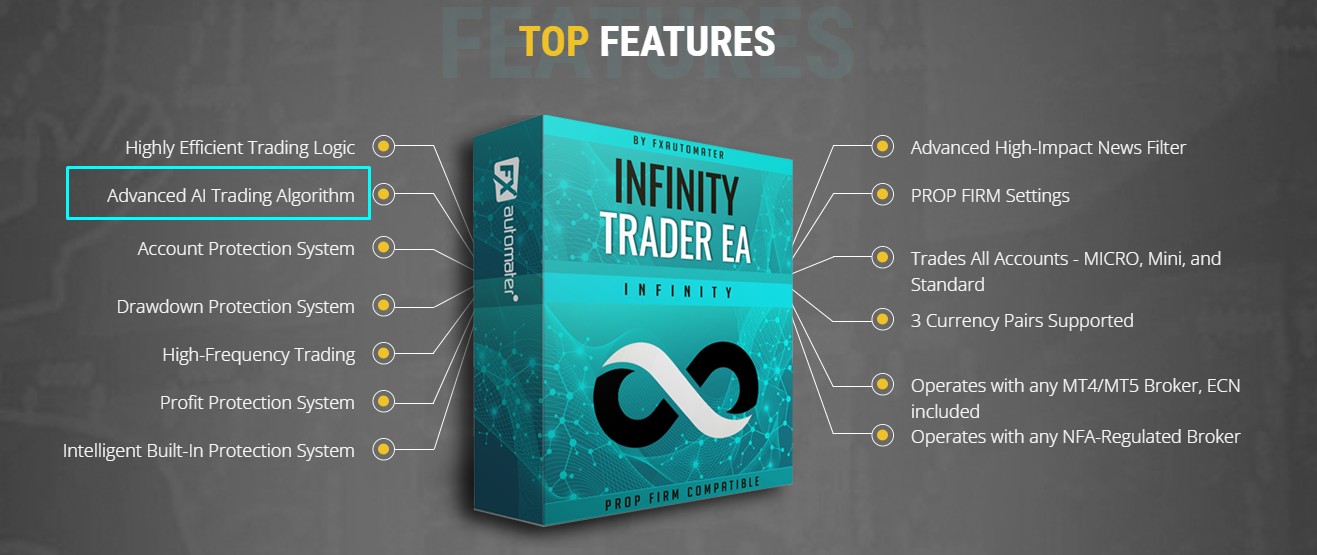
Highly practical features that reflect Infinity Trader EA’s core functionality:
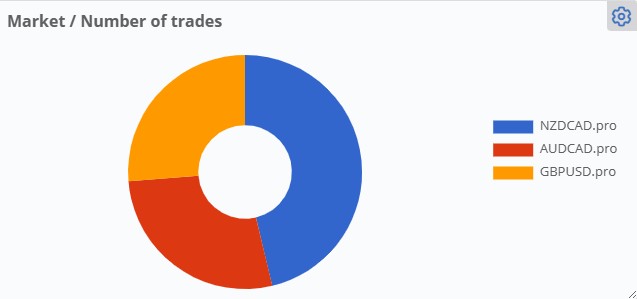
Infinity Trader EA operates exclusively on AUD/CAD, GBP/USD, and NZD/CAD using the M15 timeframe , three pairs selected through rigorous backtesting for their compatibility with mean reversion logic. This deliberate focus ensures the strategy is applied only where its underlying patterns have demonstrated statistical relevance.
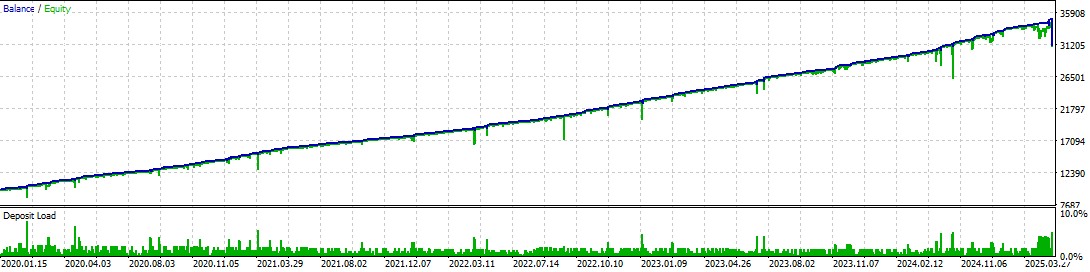
Historical testing spans extended data periods across all three supported pairs, stress-testing the mean reversion logic under varied market conditions. Results cover key metrics including drawdown depth, win rate, and trade frequency, giving traders a structured performance baseline before any live capital is committed.
Backtests provide useful context, but live account data tells a more complete story. Verified performance records show how Infinity Trader EA behaves under real trading conditions, actual spreads, live execution, and genuine market volatility, offering a more credible basis for evaluating the strategy's real-world consistency.
Performance transparency goes beyond profit totals. A clear breakdown of winning versus losing trades shows the true nature of the strategy's edge, including average win size, average loss size, and overall trade distribution. Understanding this ratio gives a more honest view of what to expect during both favorable and difficult market periods.


Infinity Trader EA delivers a strong blend of precision trading, adaptive risk control, and long-term consistency—making it a solid choice for both retail and prop-firm traders.

Uses sentiment-powered signals and historical pattern recognition to time entries with high accuracy.

Trades are triggered based on statistically validated price-action patterns—no martingale or grid behavior involved.

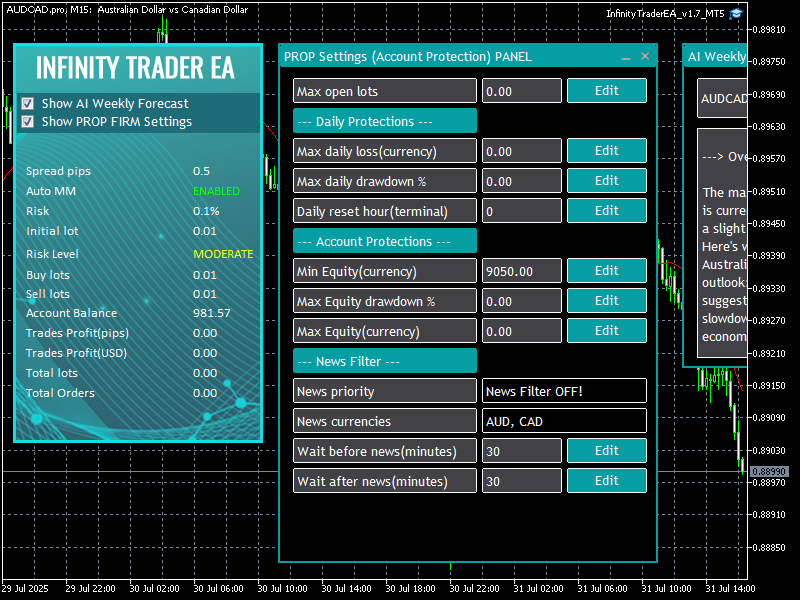
Includes customizable risk controls such as max drawdown limits, fixed stop-loss, and equity protection settings.

Specially tuned for AUDCAD, GBPUSD, and NZDCAD on the M15 timeframe—each with its own logic variation.

Fully compatible with prop-firm rules (e.g., no martingale, FIFO compliance, and risk caps).

Purchase includes free updates and ongoing support to keep your strategy running efficiently long-term.
Infinity Trader EA is built for traders who want a clean, rules-based system that does not rely on grid structures, martingale recovery, or high-frequency speculation. The mean reversion approach is methodical by nature; it suits traders who prefer a strategy grounded in statistical reasoning over one that chases momentum or compounds risk during losing periods.
If aggressive recovery systems or uncapped drawdown exposure concern you, Infinity Trader EA's design philosophy will likely feel more appropriate. The absence of grid and martingale logic, combined with configurable drawdown limits, reflects a more conservative approach to automated trading, one that prioritizes capital protection alongside return potential.
The EA is detailed enough to reward traders who take the time to understand its configuration, but accessible enough that intermediate users can set it up without advanced technical knowledge. The included parameters are clearly defined, and the set-and-forget operation removes the need for constant involvement once it's running.
Running continuously on M15 across three pairs, the EA handles entries, exits, and risk management without requiring manual oversight throughout the day. For traders managing other commitments during market hours, that level of automation is a practical advantage, provided a VPS is in place to maintain consistent connectivity.
If these pairs already feature in your trading approach, Infinity Trader EA fits naturally into that focus. The strategy was built specifically around their price behavior, which means you are not asking the system to operate in markets it was not designed for, a distinction that matters more than it might initially seem.
The 30-day money-back guarantee and lifetime update policy are worth noting, particularly for traders who have had poor experiences with EAs that go unsupported after purchase. Ongoing updates matter for a system that incorporates AI sentiment analysis; the underlying inputs benefit from refinement over time, and that requires an active development commitment.
Whether you’re a novice or an advanced trader, here’s what you should know:
Infinity Trader EA trades three specific currency pairs , AUD/CAD, GBP/USD, and NZD/CAD , exclusively on the M15 timeframe. These pairs were not chosen arbitrarily. Each went through an extensive backtesting process to confirm that the EA's mean reversion logic performs consistently across their price behavior patterns. Focusing on a defined set of instruments, rather than casting a wide net, generally produces more reliable results over time , and that philosophy is reflected in how this EA is built.
No. Infinity Trader EA does not use grid structures or martingale-based position sizing. The strategy is grounded in statistically tested price-action patterns combined with AI sentiment analysis, which means each trade is assessed on its own merit rather than being part of a compounding recovery sequence. This is a meaningful distinction. Grid and martingale systems can produce consistent short-term results but carry tail risks that are difficult to manage. Infinity Trader EA was designed to avoid that category of exposure entirely.
Risk management is built directly into the EA's core logic. Traders can set maximum drawdown thresholds, define lot sizing relative to account balance, and configure stop-loss and take-profit levels to suit their individual risk tolerance. These parameters are adjustable, which matters , what works for a $5,000 account may not be appropriate for a $500 one. The built-in controls provide a meaningful layer of protection, though sensible capital allocation on the trader's side remains an important part of the overall picture.
Yes, Infinity Trader EA is designed for fully automated operation. Once installed and configured, it manages trade entries, exits, and ongoing risk without requiring manual involvement. That said, periodic monitoring of account equity and EA behavior is still a reasonable habit. Automation handles execution reliably, but reviewing performance data occasionally, even briefly, gives traders a clearer sense of how the system is behaving under current market conditions and whether any configuration adjustments are warranted.
Yes. Every purchase includes lifetime updates and access to developer support five days a week. The EA is also backed by a 30-day money-back guarantee, which provides a practical window for evaluation before committing long-term. Updates are particularly important for an EA that incorporates AI sentiment analysis, as the underlying models and data inputs benefit from ongoing refinement. Knowing that post-purchase support is available adds a meaningful layer of confidence, especially for traders who are newer to automated systems.
Trade entries are triggered by a combination of price-action pattern recognition and AI-driven sentiment analysis working together. The EA doesn't act on a single signal in isolation; it waits for multiple conditions to align before placing an order. This includes assessing the current price relative to a statistically defined mean, evaluating momentum context, and checking that market conditions fall within acceptable parameters. The result is a more selective entry process, which tends to produce fewer but higher-quality trade setups compared to systems that trade on simpler, single-indicator logic.
The EA is built around mean reversion principles, so it generally looks for situations where the price has moved away from its statistical average and shows signs of returning. Specific patterns it monitors include:rnrnOverextended price moves away from established value zonesrnMomentum exhaustion signals suggesting a directional move is losing strengthrnSentiment divergence, where AI-assessed market bias contrasts with recent price actionrnDefined support and resistance confluences that add weight to a potential reversalrnrnNo single pattern triggers a trade on its own. It is the combination of these factors that produces the entry signal.
Exits are managed through pre-configured take-profit targets, though the EA also monitors real-time conditions as a trade progresses. If the price reaches the defined target level, the position closes automatically. Trailing stop logic may also be applied depending on configuration, allowing the EA to lock in partial gains on trades that move further than expected. The system does not hold positions indefinitely waiting for larger returns; exits are structured around the mean reversion premise, closing once the anticipated price correction has played out.
Several layers of protection are built into the system. A maximum drawdown threshold can be set, beyond which the EA pauses new trade activity to prevent further equity loss during unfavorable periods. Lot sizing is tied to account balance rather than fixed values, which means position sizes scale appropriately as the account grows or contracts. Stop-loss levels are applied to every trade without exception. Together, these controls create a risk framework that is perhaps more structured than what many competing EAs offer, though no system removes the possibility of drawdown entirely.
Performance tracking is straightforward within MetaTrader. The account history tab provides a full record of closed trades, including entry and exit prices, profit and loss figures, and trade duration. For a more detailed view, tools like Myfxbook or MetaStats can connect directly to the trading account and generate visual performance reports. Monitoring metrics such as win rate, average trade duration, maximum drawdown, and profit factor over time gives a clearer picture of how the EA is performing, and whether any parameter adjustments might be worth considering.
A few indicators suggest the system is operating as expected:rnrnTrades are opening and closing in line with configured parametersrnPosition sizes correspond correctly to the lot sizing rules you've setrnStop-loss and take-profit levels are visible on every open tradernThe EA is active on the correct pairs and timeframe, AUD/CAD, GBP/USD, and NZD/CAD on M15rnNo unusual error messages appear in the MetaTrader journal tabrnrnIf trades stop appearing entirely during active market hours, or if lot sizes seem inconsistent, those are worth investigating; usually, a connection issue or a misconfigured parameter is the cause.
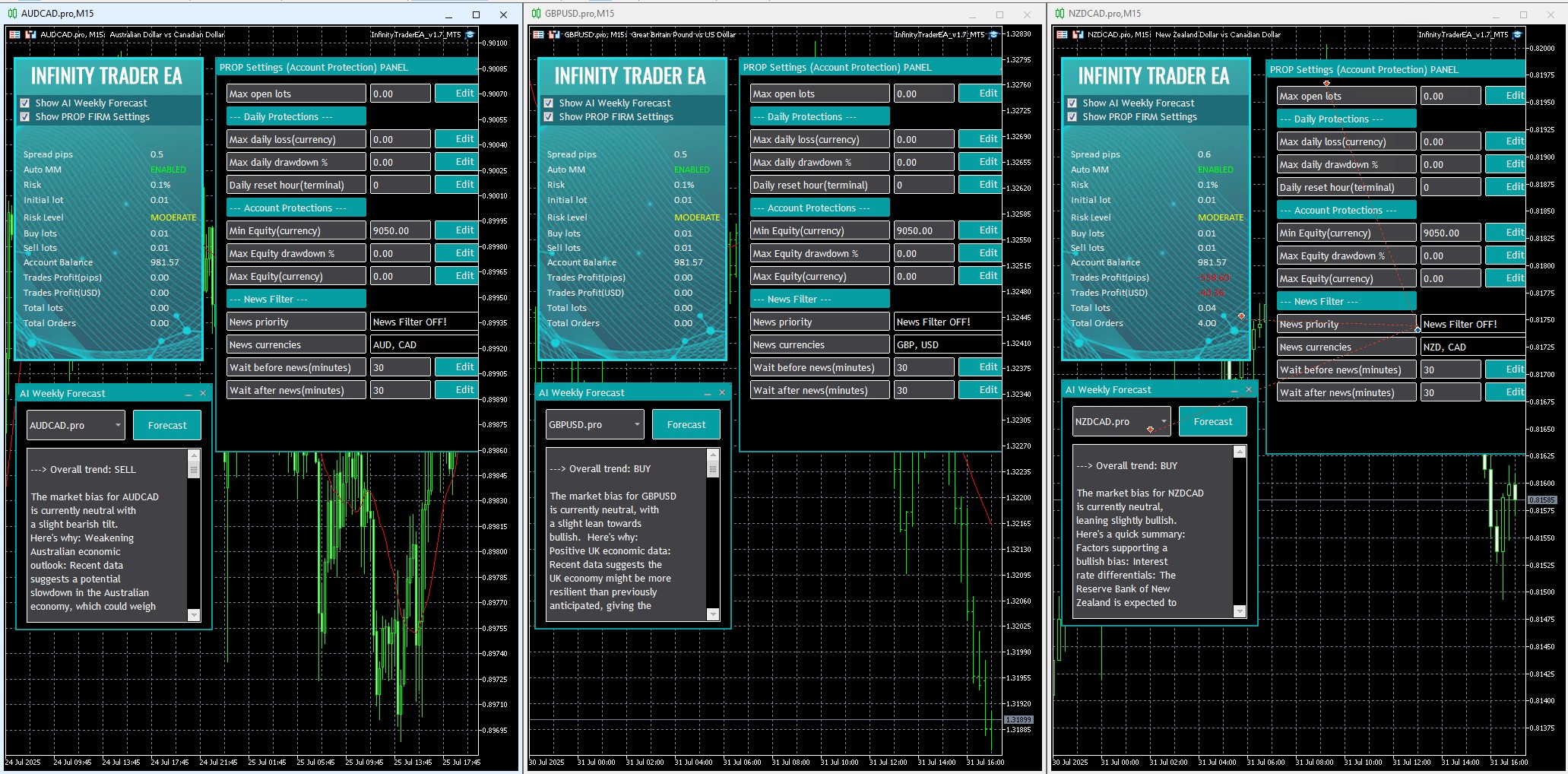
Yes. The EA can run on all three supported pairs simultaneously, which is actually the recommended setup. Running it across AUD/CAD, GBP/USD, and NZD/CAD at the same time distributes trade opportunities across three instruments rather than concentrating activity on one. This broader exposure can smooth overall equity performance, since the pairs don't always move in perfect correlation. Each chart instance operates independently, so one pair's activity does not interfere with another's. A reliable VPS is advisable when running multiple instances to ensure consistent uptime.
It can, though a degree of caution is warranted. Running multiple EAs on the same account increases total position exposure, and if other systems also hold open trades on the same pairs, the combined risk can grow quickly. Before running Infinity Trader EA alongside other systems, it is worth reviewing whether the strategies are genuinely complementary or simply doubling up on similar market positions. Reducing lot sizes on each EA when running them together is a reasonable starting point; testing the combination on a demo account first is the more prudent approach.
Diversification has genuine merit in automated trading, though it introduces its own complexities. Running several EAs across different strategy types, mean reversion, trend following, and perhaps a breakout system, can reduce dependence on any single approach performing well in all conditions. That said, more EAs also means more parameters to monitor, more potential for overlapping exposure, and a greater risk of over-complicating what could be a manageable setup. Starting with one system, understanding it thoroughly, and expanding from there tends to be a more grounded approach than loading multiple EAs simultaneously from the outset.
Yes, settings can be adjusted at any point after installation. Parameters such as lot size, maximum drawdown, stop-loss and take-profit levels, and trading session times can all be modified through the EA's input panel in MetaTrader. It is worth noting that changes take effect on new trades; any positions already open will continue running under the settings that were active when they were placed. Making significant adjustments during an active trading period is generally best avoided. Testing new configurations on a demo account before applying them live is a practical step worth taking.
Infinity Trader EA is built for traders seeking smart automation, advanced entry logic, and robust capital protection—all without the risks of grid or martingale systems. With deep optimization for AUDCAD, GBPUSD, and NZDCAD on the M15 timeframe, it’s a precision tool for consistent performance. Whether you’re trading personal accounts or scaling into prop-firm challenges, Infinity Trader EA is engineered to support your goals.