A next-gen grid trading robot powered by AI and Deep Learning—engineered for high-frequency trading on NZDUSD, AUDNZD, GBPCHF, and more.
Perceptrader AI Expert Advisor combines artificial intelligence and grid trading to deliver a smarter, data-driven trading experience. Built upon the successful Waka Waka strategy, it integrates deep neural networks, machine learning, and real-time market forecasts via ChatGPT and Google Bard. Unlike typical EAs, it continuously evolves by analyzing large datasets and filtering out low-probability trades using supervised learning. Whether you’re managing your own capital or trading under FTMO or FIFO restrictions, this EA adapts across brokers and environments. Its Unique Mode ensures your trades stand apart from the crowd—ideal for portfolio differentiation and prop firm compatibility.
Read Our Hands On Review
Perceptrader AI doesn’t just place trades—it makes informed, AI-optimized decisions at lightning speed. Designed for serious traders who want both strategy depth and modern automation.
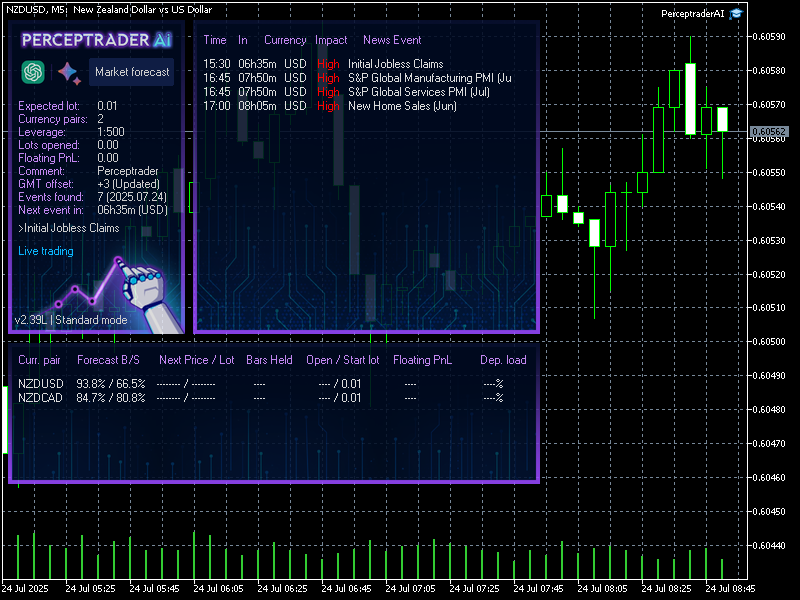
Perceptrader AI runs simultaneously across six currency pairs, AUD/CAD, AUD/NZD, GBP/CHF, NZD/CAD, NZD/USD, and USD/CAD, on the M5 timeframe. Each pair operates independently, with its own AI-filtered grid logic, spreading trade activity across multiple instruments rather than concentrating risk on a single market.
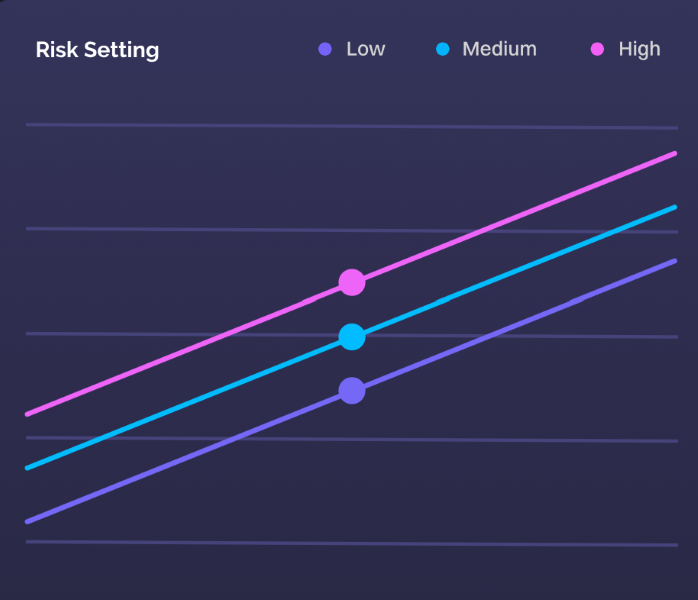
Pre-configured risk profiles cover a wide range of trading styles, from conservative low-drawdown settings designed for capital preservation to more active configurations for traders comfortable with higher exposure. Switching between profiles requires no manual recoding, making risk adjustment straightforward as account conditions or objectives change.
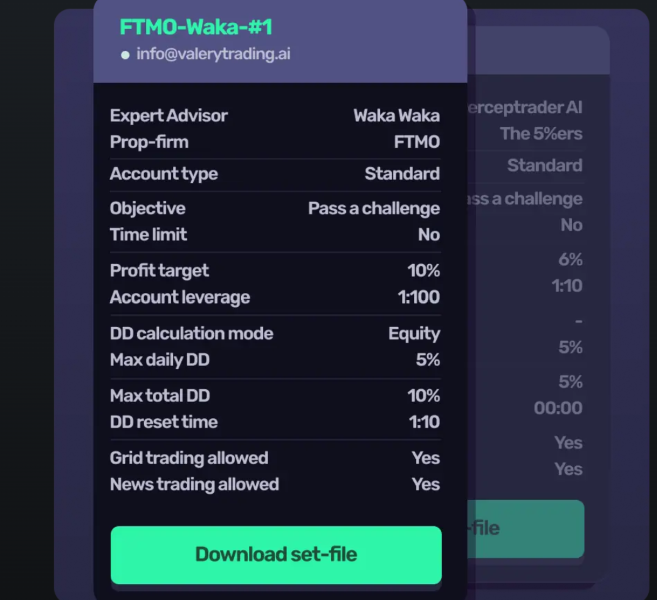
Dedicated configuration files are included for traders pursuing funded account evaluations. These settings are designed around common prop firm requirements, including drawdown limits and FIFO compliance, giving traders a structured starting point rather than having to reverse-engineer suitable parameters independently before an evaluation begins.
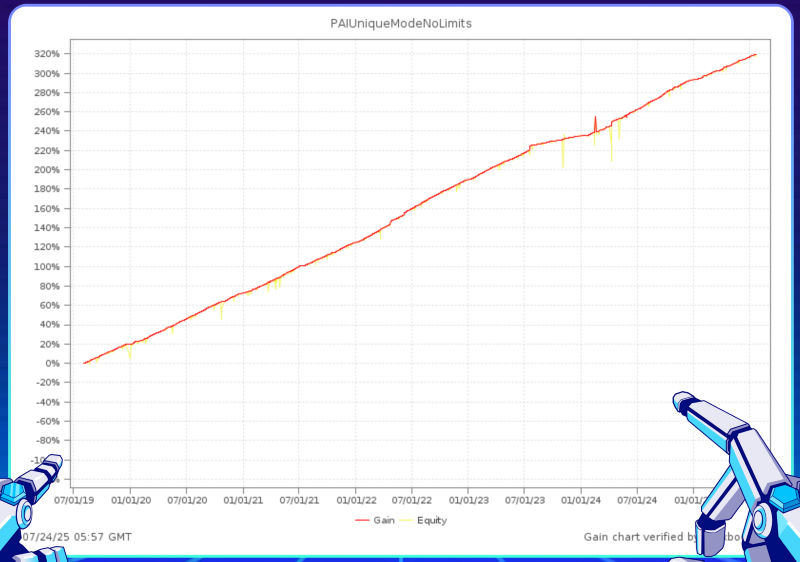
Verified performance data spans more than five years across the supported pairs, providing a meaningful track record across multiple market cycles. An extended performance history carries more weight than short-term results; it captures how the system behaves through trending periods, range-bound phases, and unexpected volatility events alike.
The neural network at the core of Perceptrader AI was trained on pattern recognition and statistical analysis across historical price data. It functions as an intelligent pre-filter, assessing setup quality before each grid cycle begins, and can be retrained on broker-specific data to improve its accuracy over time.


Perceptrader AI Expert Advisor is built for efficiency, adaptability, and profitability, incorporating years of tested data and intelligent market filtering.

Backed by Waka Waka’s proven strategy with intelligent AI trade layering.

Optimized for short-term scalping and intra-day grid opportunities.

Supports NZDUSD, AUDNZD, GBPCHF, AUDCAD, and more in one setup.

Eliminates low-potential setups via machine learning in real time.

FIFO/FTMO friendly setup for funded traders.

Built-in filters for news, New Year holidays, and cash volatility.
Perceptrader AI sits at the more advanced end of the automated trading spectrum. The combination of machine learning, a multicurrency grid system, and an M5 operating timeframe makes it a system that rewards informed, engaged traders , rather than those looking for a completely hands-off experience with minimal setup involvement.
The martingale-based grid structure is not a system to run without understanding what it involves. Traders who already have experience with grid EAs and who understand how to size capital appropriately for that type of exposure will find Perceptrader AI's AI filtering layer a meaningful improvement over conventional alternatives.
The dedicated prop firm configuration files and FIFO-compliant trade management make this EA a practical option for traders working through funded account evaluations. Having settings specifically built around evaluation constraints removes a significant amount of manual configuration work, which is genuinely useful when operating within strict drawdown parameters.
The ability to retrain the neural network using your own broker's data is a feature that will appeal to traders who want more than a static system. If you're the type of person who reviews performance logs, considers market regime changes, and wants to actively shape how the EA adapts, this is a more engaging tool than most alternatives at this price point.
Running six currency pairs simultaneously distributes activity across instruments that don't move in perfect correlation. For traders who prefer spreading risk across multiple positions rather than concentrating on one or two pairs, the multicurrency structure fits that preference naturally, provided per-pair lot sizes are scaled accordingly.
The $1,000+ price point reflects the EA's positioning as a professional-grade tool, and the capital requirements for running a multicurrency grid system responsibly reinforce that. This is perhaps not the right fit for traders working with minimal account sizes. Those with sufficient capital to absorb drawdown across multiple active grid cycles will find the risk profile considerably more manageable.
Here are some common questions traders ask about Perceptrader AI EA:
Yes, but with an important distinction. Perceptrader AI applies a martingale-based grid structure, which on its own would be considered high-risk. What separates it from conventional grid systems is the AI-driven filtering layer that sits in front of every entry decision. The neural network assesses setup quality before allowing a new grid cycle to begin, reducing exposure to low-probability conditions. It's still a martingale system at its core, so capital allocation and risk settings deserve careful thought, but the AI component does meaningfully change how it behaves.
Yes. Perceptrader AI was built with prop firm compliance in mind. It respects FIFO trade management rules and includes low-drawdown configuration options specifically suited to evaluation phase requirements. Given how strict most funded account providers are about drawdown limits and trade behavior, having dedicated settings for this use case is a genuine advantage. That said, traders should always verify their specific firm's rules before deploying any EA; prop firm conditions vary, and it's worth confirming compatibility before the evaluation begins.
Yes. One of the more technically advanced features of Perceptrader AI is the ability to retrain its neural network using your own broker's historical data. This matters more than it might initially seem. Different brokers have different feed characteristics, spread behavior, and execution patterns. A model trained on generic data may not perform as well as one tuned to your specific trading environment. The retraining process allows the EA to adapt over time, which is a meaningful advantage for traders committed to long-term deployment.
A VPS is required, not optional. Perceptrader AI operates on the M5 timeframe across multiple currency pairs, which means it needs consistent, low-latency connectivity to function correctly. Running it on a home computer introduces real risks; internet interruptions, system restarts, and power outages can all interfere with open grid cycles in ways that are difficult to recover from. A VPS hosted near your broker's servers keeps execution clean and reliable. One month of free ValeryVPS hosting is included with the purchase, which is a practical way to get started without additional cost.
There's a 14-day free trial available before committing to a purchase, which gives enough time to evaluate how the EA behaves on a demo account under real market conditions. After purchase, a 30-day money-back guarantee provides a further window if the system doesn't meet expectations. The included month of free VPS hosting through ValeryVPS also removes one of the typical setup costs during that initial period. Few EAs in this price range offer this level of post-purchase flexibility; it reflects a degree of confidence in the product.
A grid cycle does not begin on a fixed trigger or simple indicator crossover. Instead, the neural network processes pattern recognition data and statistical analysis across recent price behavior before approving a new sequence. Entry conditions are assessed against the EA's trained model, and only setups that meet a defined confidence threshold proceed to execution. This filtering step is central to how Perceptrader AI differs from standard grid EAs; cycles are initiated selectively, not mechanically, which reduces the frequency of sequences starting in unfavorable conditions.
The EA performs best in conditions where price oscillates within a reasonably defined range, or where directional moves are gradual rather than sudden. The six supported pairs, AUD/CAD, AUD/NZD, GBP/CHF, NZD/CAD, NZD/USD, and USD/CAD, were selected partly because of their tendency toward structured, mean-reverting behavior over time. Conditions that tend to work less well include sustained one-directional trends, post-news continuation moves, and sharp liquidity gaps. The AI filtering layer helps reduce exposure to some of these scenarios, though it cannot eliminate them entirely.
Yes. The EA includes filters designed to detect and respond to abnormal market conditions. These cover spread widening, low-liquidity windows, and volatility spikes that fall outside the parameters the neural network was trained on. During these periods, new cycle initiation is suppressed until conditions normalize. High-impact news events are a common trigger for this kind of pause. Traders can also configure session time restrictions manually to exclude known difficult windows. Combining both the built-in filters and manual session limits tends to produce the most consistent results.
The neural network was trained on historical price data across the supported pairs, learning to recognize pattern sequences associated with favorable and unfavorable outcomes. In practice, it acts as a pre-filter , assessing whether the current market state matches the types of conditions where the grid strategy has historically performed well. This doesn't guarantee every cycle s쳮ds, but it does reduce the frequency of cycles starting in structurally weak setups. Over time, and particularly after retraining on broker-specific data, the model's pattern recognition becomes more closely matched to actual trading conditions.
The developer releases periodic model updates as part of the EA's ongoing maintenance. Beyond official updates, traders can also retrain the model independently using their broker's data at any point, a feature that gives users more direct control over how current the model's learning remains. How often retraining makes sense depends on how much market behavior has changed since the last session. Quarterly retraining is a reasonable starting point, though traders running the EA through significant macro regime changes may find more frequent sessions worthwhile.
This is the core risk scenario for any grid-based system, and Perceptrader AI addresses it through several configurable safety mechanisms. A maximum grid level cap prevents the sequence from extending beyond a defined number of positions. Lot size limits contain position growth within acceptable bounds. Beyond those parameters, the EA's AI layer attempts to assess whether continuation is statistically justified; if not, new additions within the cycle may be paused. That said, a sustained trending move against a fully open grid remains the most challenging scenario for any system of this type, and appropriate capital allocation is the primary safeguard.
Each supported pair operates as an independent instance, with its own grid cycles, risk parameters, and AI assessment running separately. The EA does not consolidate position management across pairs; AUD/CAD activity, for example, has no direct bearing on how USD/CAD trades are handled. This separation keeps the logic clean and prevents one pair's active cycle from influencing another's entry decisions. The practical implication is that overall account exposure can increase during periods when multiple pairs are simultaneously in active grid sequences, which is worth monitoring.
It can, but doing so requires careful consideration of combined exposure. Running additional EAs on the same account increases total open position risk, and if other systems also trade correlated pairs, the overlap can grow quickly during volatile periods. Before combining Perceptrader AI with other systems, it's worth mapping out which pairs each EA trades and whether their activity periods overlap. Reducing lot sizes across all systems when running them together is a sensible precaution. Testing the combined setup on a demo account before going live is, I think, the most prudent approach here.
Grid systems, regardless of how sophisticated their entry logic is, face their greatest challenges in sustained trending markets. Specifically:rnrnStrong directional trends that continue without meaningful retracements force grid levels to stack up without reaching the take profitrnPost-news momentum continuation moves are particularly difficult because they can be both fast and extendedrnLow-liquidity gaps, common around market opens and weekend sessions, can skip grid levels entirelyrnCorrelated macro moves affecting multiple pairs simultaneously can increase total account exposure rapidlyrnrnPerceptrader AI's AI filtering reduces exposure to some of these conditions, but no system eliminates trending risk in a grid-based framework entirely.
Whether you're a grid strategy enthusiast, a funded trader, or a tech-savvy scalper, Perceptrader AI Expert Advisor delivers AI-enhanced trade decisions with minimal manual intervention. Backed by real MyFxBook and MQL5 signals and integrated forecasting, it’s not just an EA—it’s your trading edge.