A proven algorithmic trading system engineered to profit from inefficiencies in AUDCAD, AUDNZD, and NZDCAD using advanced grid logic and smart market mechanics.
Waka Waka EA isn’t your average grid bot. With over 6 years of real account trading behind it, this system is designed to exploit consistent inefficiencies found in specific minor cross pairs. Rather than curve-fitting past data, it’s grounded in a rules-based strategy that leverages actual market behavior. Operating on the M15 timeframe, Waka Waka EA utilizes grid logic intelligently, backed by robust risk management and decades of tested data. It’s suitable for serious traders looking for long-term, sustainable performance — not just simulated backtest success.
Read Our Hands On Review
Waka Waka EA is built to combine technical precision with practical performance. From powerful filters to one-chart multi-pair execution, every component supports consistency, control, and clarity in trading.
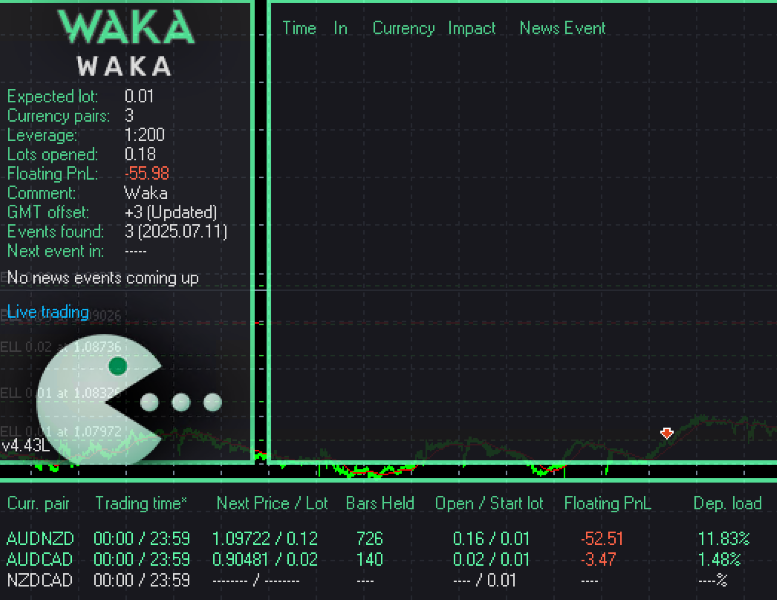
Waka Waka EA runs simultaneously across AUD/CAD, AUD/NZD, and NZD/CAD on the M15 timeframe, three pairs selected for their range-bound tendencies and compatibility with grid logic. Each pair operates independently, distributing activity across instruments with moderate correlation rather than concentrating exposure on a single market.
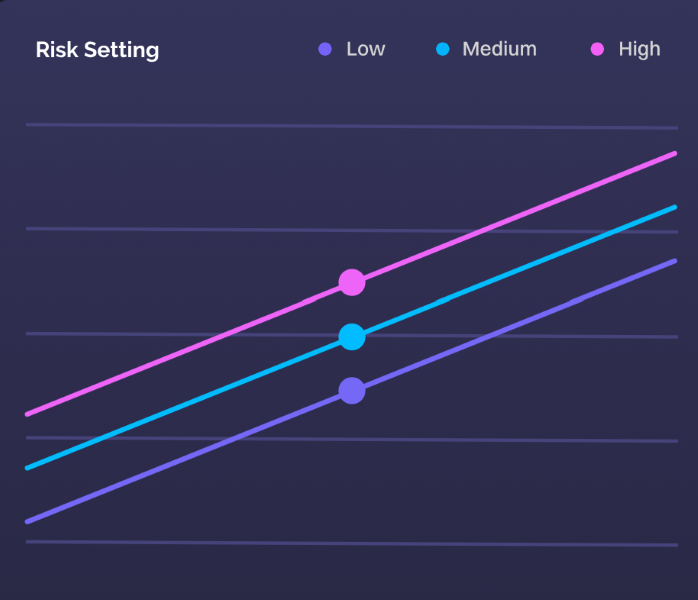
Conservative, balanced, and aggressive configurations are available out of the box, each with pre-set lot sizing, grid spacing, and drawdown thresholds suited to different capital levels and risk tolerances. Adjusting between profiles requires no manual recoding, making it straightforward to scale risk as account size and confidence develop over time.
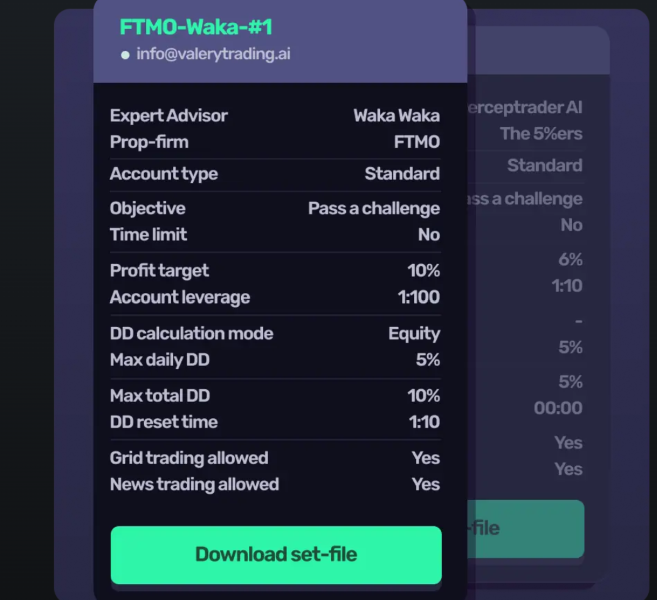
Dedicated configuration files for prop firm evaluations are included, designed around standard funded account requirements, FIFO compliance, drawdown boundaries, and controlled position sizing. These remove the need to build a compliant setup from scratch, giving traders a structured, evaluation-ready configuration before the assessment period begins.
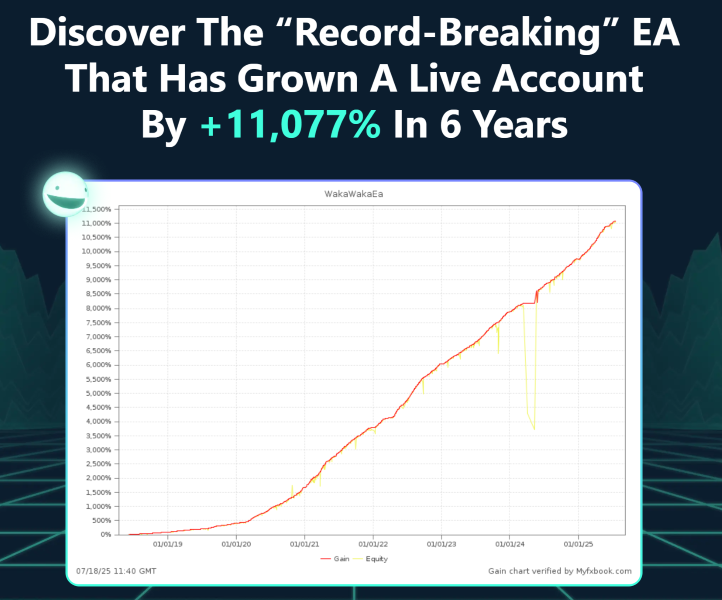
Waka Waka's verified performance history includes results that stand out within the grid EA category, not just in raw return figures, but in consistency across extended periods and varied market conditions. The track record spans multiple years of live account data, providing a credible basis for assessing long-term system behavior.


A closer look at what defines Waka Waka EA’s edge — from mechanics to execution traits.

Verified performance via MyFxBook and MQL5 - not just hypothetical results.

Tailored for specific cross pairs with well-known inefficiencies.

Not reckless doubling - calibrated lot scaling based on account size and risk set.

Compatible with most brokers thanks to smart execution logic.

Passes FTMO-style requirements and can comply with FIFO rules.
Waka Waka EA suits a fairly specific type of trader , one who understands how grid systems work, accepts the risk profile they carry, and has the capital to run them responsibly. It's not a system for everyone, and being straightforward about that is more useful than suggesting otherwise.
Understanding what a grid system does during a trending market, and why that matters, is a reasonable prerequisite for running Waka Waka effectively. Traders who already know what they're working with will find the AI filtering and configurable risk parameters a genuine step forward compared to simpler alternatives they may have used previously.
The recommended starting range of $1,000 to $6,000, depending on risk profile, reflects the capital cushion a grid strategy genuinely needs. Underfunding this type of system is one of the more common mistakes traders make; the consequences tend to show up during the first extended drawdown period. Those who size their capital appropriately from the outset will find the system considerably more manageable.
The included prop firm configuration files and FIFO-compliant trade management make Waka Waka a viable option for funded account evaluations. The M15 timeframe and controlled grid logic produce a less erratic equity curve than high-frequency alternatives , which tends to be an advantage when drawdown metrics are being closely monitored by a prop firm.
If AUD/CAD, AUD/NZD, and NZD/CAD already feature in your trading approach, the EA's logic fits naturally into that focus. The entry filters and grid parameters were built specifically around the price behavior of these instruments. Applying the system to pairs it wasn't designed for is an option that rarely ends well, and the specificity here is a strength, not a limitation.
Waka Waka runs autonomously once configured, but it does so within a clearly defined risk framework rather than operating without limits. For traders who want genuine set-and-forget functionality without sacrificing control over maximum exposure, that combination of automation and defined parameters is, I think, one of the system's more compelling characteristics.
Here are common questions traders ask before running Waka Waka EA.
No. Once configured and running on a VPS, Waka Waka operates autonomously without requiring ongoing manual input. Built-in diagnostic tools monitor system health, while news avoidance filters pause activity around high-impact economic releases. The EA handles trade entries, position management, and exits independently. That said, periodic review of account equity and open basket status remains a sensible habit; full automation does not replace the value of an informed trader checking in regularly, even briefly.
Waka Waka uses a controlled form of Martingale, but the word "controlled" carries real weight here. Position sizing within grid sequences is governed by strict risk parameters, and traders can choose between conservative, balanced, or aggressive profiles depending on their capital and tolerance for drawdown. It is not an uncapped system. The risk boundaries are defined and configurable. Still, it's worth being clear: any Martingale-based approach carries inherent tail risk during sustained trending conditions, and choosing the appropriate profile for your account size genuinely matters.
Waka Waka is compatible with most brokers, including those that enforce FIFO rules. The more important consideration is execution quality; tight spreads and fast order processing make a meaningful difference to how the grid logic performs in practice. A VPS hosted close to your broker's servers is strongly recommended. Some brokers handle the AUD/CAD, AUD/NZD, and NZD/CAD pairs with better conditions than others, so it's worth comparing a few options rather than defaulting to whatever account you currently have.
Waka Waka is specifically optimized for AUD/CAD, AUD/NZD, and NZD/CAD. These three pairs were selected because their price behavior, particularly their tendency toward range-bound movement and mean-reverting patterns, aligns well with the underlying grid and pattern recognition logic. Applying the EA to pairs outside this scope is technically possible but not advisable. The parameters, spacing logic, and entry filters were built around these instruments specifically. Using it elsewhere may produce unpredictable results that don't reflect the system's actual design intent.
Every purchase includes a 14-day free trial period, a 30-day money-back guarantee, and one free month of ValeryVPS hosting , which covers the infrastructure side during initial setup. Beyond that, buyers gain access to a private Telegram support group where the development team and other users share configuration guidance, updates, and practical insights. Having a direct support channel is particularly useful for a system this configurable; there are enough parameters that real-world guidance from experienced users can make the setup process considerably smoother.
Capital requirements vary depending on the risk profile selected. Backtesting scenarios used starting balances ranging from $1,000 to $6,000 across different configurations. For lower-risk settings, such as a 0.25% load, a $6,000 starting balance provides a comfortable safety margin. Higher-risk configurations can technically run from $1,000, but the drawdown exposure increases significantly at that level. A practical rule of thumb: multiply your maximum acceptable drawdown by two when choosing your risk setting. The grid strategy introduces variability over time that requires adequate capital to absorb without disrupting overall account health.
A grid cycle begins when the EA's pattern recognition layer identifies conditions consistent with a range-bound or mean-reverting market phase on the M15 chart. Rather than triggering on a single indicator, the decision combines multiple signals, including price position relative to statistical norms, momentum readings, and volatility context. The AI component assesses whether current conditions match historical patterns associated with favorable grid performance. If the criteria are not met, the EA waits. This selectivity is part of what separates Waka Waka from simpler grid systems that open cycles indiscriminately.
Both indicators play a role in the entry validation process. RSI readings help the EA assess whether the price is approaching overbought or oversold territory, conditions that historically precede reversals on the pairs Waka Waka trades. Bollinger Bands provide a visual and statistical framework for identifying where the price sits relative to recent volatility. When price touches or moves beyond the outer bands while RSI signals exhaustion, the combination creates a higher-confidence entry context. Neither indicator acts as a standalone trigger; they work together as part of a broader signal confirmation process.
When the initial trade moves into a loss beyond a defined threshold, the EA places a subsequent order at a lower price level and continues doing so at calculated intervals as the price moves further against the position. Each new order in the sequence is sized according to the selected risk profile, with the overall basket designed to close at a profit once the price recovers to a calculated breakeven point. The spacing between grid levels is not fixed arbitrarily; it reflects the volatility characteristics of the specific pair being traded, which is why the three supported instruments were chosen deliberately.
This is the scenario that demands the most honest answer. A sustained directional move against an open grid sequence is the primary risk for any system of this type. Waka Waka addresses it through maximum trade count limits, lot size caps, and configurable drawdown thresholds that pause new additions when exposure reaches defined boundaries. The AI filtering layer also attempts to avoid initiating cycles during high-directional-momentum conditions. None of these safeguards eliminates the risk entirely; they reduce the frequency and severity of exposure. Adequate starting capital and appropriate risk profile selection remain the most important protections available to the trader.
Each open position within a grid basket is tracked independently, with the EA monitoring the collective floating profit or loss of the entire sequence rather than individual trades in isolation. Take profit targets are calculated at the basket level, meaning all positions in a sequence close together once the combined target is reached. This approach is standard for grid systems and works well during ranging conditions where price oscillates back toward the entry zone. Running all three pairs simultaneously adds another layer of complexity, since each pair maintains its own independent basket without cross-pair interference.
For conservative operation, the lower-risk profiles, typically around 0.25% load settings, are the appropriate starting point. These configurations use smaller lot sizes relative to account balance, wider grid spacing, and lower maximum trade counts per sequence, all of which reduce the depth of potential drawdown during adverse moves. A starting balance of at least $6,000 is advisable at this level. Perhaps more importantly, conservative settings also mean lower returns during favorable periods; that trade-off is real and worth accepting consciously rather than discovering after the fact during a difficult market phase.
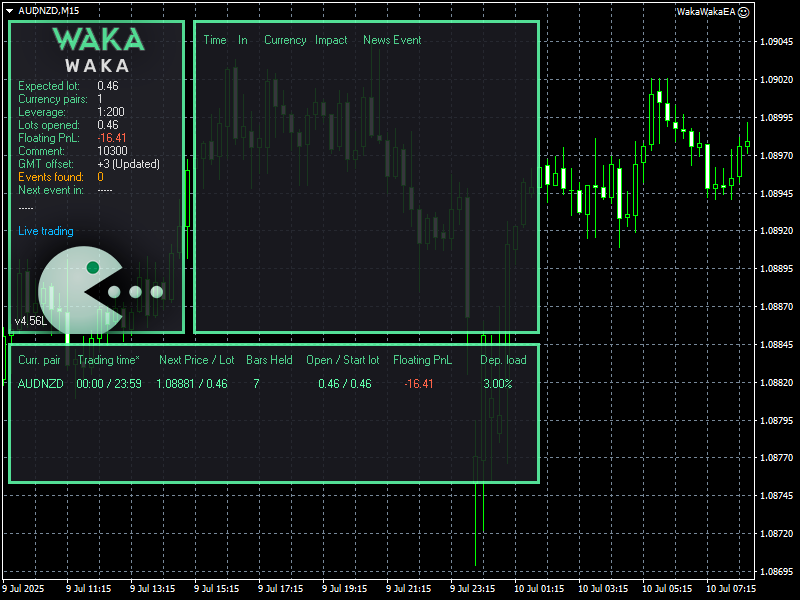
MetaTrader's built-in terminal provides a live view of all open positions, including individual trade profit/loss figures and overall account equity. For a more structured view of active grid baskets, the EA's on-chart display shows current sequence status, floating drawdown, and distance to take profit targets. Some traders also connect their accounts to third-party monitoring tools like Myfxbook for a more visual, ongoing performance record. Checking open basket status periodically, particularly during known high-volatility windows, is a straightforward habit that can prompt timely intervention if conditions deteriorate unexpectedly.
Yes, though the combination requires careful thought about combined exposure. Waka Waka trades AUD/CAD, AUD/NZD, and NZD/CAD. If additional EAs also trade these pairs or closely correlated instruments, simultaneous active sequences can increase total account risk rapidly. Running complementary systems on entirely different currency groups is a cleaner approach. Reducing per-pair lot sizes across all active EAs when combining them is essential; sizing each system as if it were the only one running tends to produce over-leveraged situations that are difficult to manage when multiple sequences are open concurrently.
Diversification within grid-based trading is a topic worth thinking through carefully. A few practical approaches:rnrnCapital allocation: Split the total trading capital across multiple accounts or systems rather than concentrating it all in one grid EArnStrategy type variety: Pairing a grid system with a trend-following or news-based EA on a separate account, spreads exposure across different market condition dependenciesrnPair selection: Waka Waka's three pairs have moderate correlation; running other EAs on uncorrelated instruments reduces the chance of simultaneous adverse movesrnRisk profile balance: Running one system conservatively while another operates at a moderate level, prevents a single aggressive configuration from dominating overall account risk rnrnDiversification doesn't eliminate risk; it distributes it more thoughtfully across different sources.
If you're looking for an expert advisor with real trading history, smart grid logic, and professional-grade execution, Waka Waka EA could be a strong fit. Designed for traders who value strategy, stability, and supported automation.