


Golden Pickaxe vs Dark Gold is a comparison between two gold robots that both win most of their trades and both open several positions at once. They get there by different routes, though: Golden Pickaxe is a grid and Dark Gold is a martingale. This page is for anyone weighing a basket-style gold EA who wants to see what each did with real money.
The deciding difference in one sentence: as of August 6, 2026, Golden Pickaxe won 91% of its trades and still lost 75% of the account, while Dark Gold won 85% and finished between −10% and +37%, over records of 11 and 14 months.
Our figures come only from live accounts we own. Dark Gold ran on 7 of them, with 4 in profit, and its trading behavior shows up across 7,952 trades. Both robots sit inside a tracking set of 527 live and funded accounts and 122,837 closed trades.
Affiliate disclosure: some links here, including the “Try Now” buttons, earn us a commission if you buy, at no extra cost to you. Commissions never change the figures, and we sell both robots reviewed here.
Key takeaways
- Both trade gold only, but Golden Pickaxe is a grid (equal-size positions) and Dark Gold is a martingale (bigger positions on losing baskets).
- Golden Pickaxe won 91% of trades beside an 82% worst drawdown, the deepest grid drawdown we have recorded.
- Dark Gold won 85% of trades beside a 34% worst drawdown, with 4 of 7 accounts in profit over 14 months.
- Golden Pickaxe returned −75% over 11 months; Dark Gold’s accounts ranged from −10% to +37%.
- A high win rate protected neither robot, and it came close to destroying one of them.
How did we track Golden Pickaxe and Dark Gold?
We ran both on accounts we fund ourselves, never customer accounts, and measured them the way we measure every robot we list.
- Worst drawdown is the largest fall in total account value from a high point to the following low, counting closed and open losses and ignoring deposits or withdrawals. A drop from $10,000 to $6,000 is a 40% drawdown.
- Worst open loss shows how far underwater the unclosed trades went at their deepest point, which exposes a robot sitting on losers while its balance looks calm.
When drawdown sits far above open loss, most of the harm came from losses the robot actually closed. If the two sit close together, positions were carried underwater. This is live tracking, not a controlled experiment, and grid and martingale accounts in our set skew young, so many have not yet met their worst month.
What is a gold EA, and which type is each robot?
An expert advisor is a program that places trades on its own inside MetaTrader 4 or MetaTrader 5. MetaQuotes’ documentation describes how each running EA is tied to a chart and can open or close positions whenever automated trading is permitted, while the terminal stays online.
We sort every robot into one of six types by what its trades show, not what its sales page says; our guide to EA strategy types lays out all six. For the basics of installation and setup, start with what an EA in forex is.
Golden Pickaxe is a grid: it opens additional gold trades as the market moves, all the same size, and does not scale up on losers. Dark Gold is a martingale: when a basket moves against it, it adds a larger trade. Both approaches produce long runs of small wins, which is exactly why their win rates look so reassuring.
How do Golden Pickaxe and Dark Gold compare side by side?
They share a market and a high win rate, and almost nothing about their outcomes. All figures are as of August 6, 2026.
How they trade
| Golden Pickaxe | Dark Gold | |
| Strategy type | Grid | Martingale |
| Markets traded | Gold only | Gold only |
| Typical holding time | Hours | Hours |
| Trades per day | 0.6 | 4.7 |
| Trades open at once | Several | Up to three |
| Adds to losing trades | No (equal-size positions) | Yes, every time |
| Best suited to | Hard to recommend on current data | Traders who accept deep open losses for a high win rate |
Live results
| Golden Pickaxe | Dark Gold | |
| Tracked for | 11 months | 14 months |
| Win rate | 91% | 85% |
| Return across accounts | −75% | −10% to +37% |
| Worst drawdown | 82% | 34% |
| Worst open loss | 19% | 30% |
I did not expect the robot with the smaller open loss to be the one that lost three-quarters of the account. That inversion is the most useful thing on this page.
What did each robot do on our accounts?
Mechanism first, then results, for each robot below.
Golden Pickaxe
Golden Pickaxe is a grid: as gold moves, it opens additional positions of equal size, collecting small profits when price oscillates. Its only market is gold, it averages about 0.6 trades daily, and positions last hours. Unlike Dark Gold, it does not enlarge positions on losing trades.
Over 11 months, Golden Pickaxe returned −75% as of August 6, 2026. Its worst drawdown reached 82%, the deepest of any grid robot we track, with its 91% win rate sitting beside that 82% figure. The open loss peaked at just 19%, so the damage came mostly from losses it closed rather than positions it carried. I have to be blunt here: we sell this robot, and in our tracking it destroyed most of the account.
CTA: Read the full Golden Pickaxe review → https://algotradingspace.com/golden-pickaxe-ea-review CTA: Download Golden Pickaxe → https://algotradingspace.com/robots/commodities/golden-pickaxe-ea CTA: Try Now → https://link.algotradingspace.com/WgCzy
Dark Gold
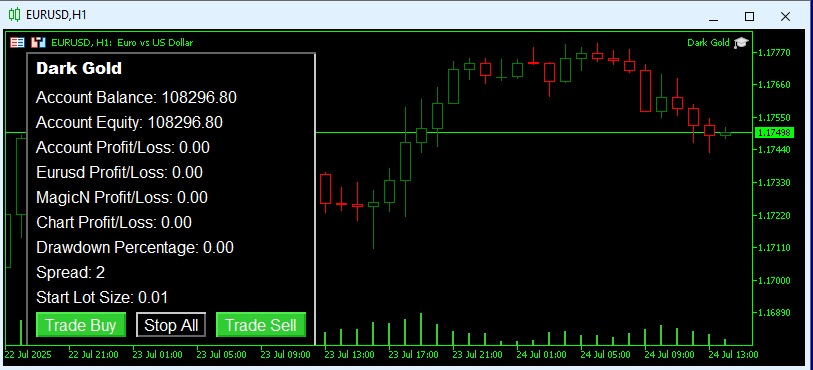
Dark Gold is a martingale. Whenever a basket goes against it, it opens a bigger trade, keeping up to three positions open, and waits for a recovery to close the group in profit. It is active around the clock at roughly 4.7 trades per day, with holds measured in hours. Across 7,952 trades on file, it scaled up on losing baskets every single time.
Over 14 months, Dark Gold’s 7 tracked accounts returned between −10% and +37%, and 4 of them were in profit as of August 6, 2026. The worst drawdown was 34% and the worst open loss 30%, while its 85% win rate sat next to that 34% drawdown. With open loss close to drawdown, Dark Gold carried its losers rather than cutting them.
Loading trading accounts…
How do they differ, criterion by criterion?
They differ on mechanism, trade frequency and above all on outcome, while sharing a market and holding time.
Mechanism
A grid adds equal-size trades as price moves; a martingale adds bigger ones. On paper that makes the grid the gentler design, since each new position carries the same risk as the last. Our data shows why that reasoning fails: equal-size positions still stack up in a sustained move, and a grid that keeps closing baskets at a loss can bleed an account without ever showing a dramatic open position. Our explainer on martingale EAs covers the other side of that trade-off.
Risk shape
Golden Pickaxe’s 82% drawdown with a 19% open loss points to repeated realized losses. Dark Gold’s 34% drawdown, set against a 30% open loss, points to baskets carried deep underwater and then recovered.
At the type level, the worst drawdown we have ever recorded is 82% for grids, which is Golden Pickaxe itself, and 93% for martingales. So neither design is safe at the extremes. On gold, Forex Gold Investor showed the martingale version of that tail: a 91% drawdown over 18 months, with returns from −61% to −4%.
Market and session
Both trade gold only, which is what makes this a fair comparison. Dark Gold spreads its entries through every trading session. For how the instrument behaves on the platform, our walkthrough on trading gold on MT4 covers the mechanics.
Trade frequency and holding time
Dark Gold trades nearly eight times as often (4.7 against 0.6 per day), and both hold for hours. More trades means more evidence: Dark Gold’s behavior is documented across thousands of fills, which makes its figures easier to trust than a thinner record.
Suitability
- Prop firm challenge: neither fits. Golden Pickaxe’s 82% drawdown and Dark Gold’s 30% open-loss swings would break any evaluation with a loss limit below those levels; our beginner’s guide to prop firm challenges explains why.
- Small account: each keeps multiple trades live together, so both need headroom. Dark Gold’s growing position size makes it the harder of the two to size on a modest balance.
- Long-term holding: Dark Gold has the longer record at 14 months, with returns from −10% to +37% beside its 34% drawdown. Golden Pickaxe’s 11 months ended at −75%, with an 82% drawdown.
Who should choose Golden Pickaxe, and who should pick Dark Gold?
On current data, the honest answer is that very few readers should choose Golden Pickaxe. Which of these fits you?
- Choose Dark Gold if you want a basket-trading robot on gold and accept martingale risk: a 34% worst drawdown over 14 months, returns of −10% to +37%, and 4 of 7 accounts profitable.
- Avoid Golden Pickaxe for now, unless you have a specific reason to believe its settings or market conditions have changed since its −75% record. Our figures cover 11 months with an 82% drawdown.
- Consider Gold Trade Pro if you prefer the grid design. It is the only other gold grid in our directory of tracked robots: a 20% drawdown and +26% return, though over just 3 months.
- Skip multi-trade robots entirely if a high win rate was what attracted you. Prime Scalper, a one-trade gold scalper, recorded a 12% drawdown with +68% to +126% over 8 months.
What goes wrong when these robots hit a bad stretch?
For Golden Pickaxe, the bad stretch never really ended. The account kept closing losing baskets while the win rate stayed high, and those losses accumulated until it sat 75% below where it started. A trader watching that account would have seen mostly green trades and a steadily shrinking balance, which is a hard pattern to recognize in time.
For Dark Gold, the worst moment meant baskets 30% underwater on screen while the robot kept adding. Most accounts recovered, but only four of seven were in profit as of August 6, 2026, the weakest at −10% over 14 months with that 34% drawdown.
What an experienced trader would do before running either:
- Track the balance, not the win rate. A 91% win rate told you nothing useful about Golden Pickaxe.
- Write down an equity stop, such as a 20% fall from the starting balance, and honor it.
- Never add funds to rescue a losing grid or martingale.
- If you have already taken a heavy loss, our guide on how to recover from a trading loss is worth reading before choosing another robot.
Verdict: Golden Pickaxe or Dark Gold?
Dark Gold is the better robot on every outcome we track: a 34% worst drawdown against 82%, returns of −10% to +37% against −75%, and a longer record, as of August 6, 2026.
That does not make Dark Gold safe. It is a martingale, and the same mechanism produced a 91% fall on another gold robot we track. I would size it as though its drawdown could one day look like that.
Golden Pickaxe, on our figures, is a robot I cannot recommend. Its 91% win rate is the clearest example we hold of why a win rate on its own is close to meaningless.
FAQs
Is Golden Pickaxe EA related to the Minecraft golden pickaxe?
Golden Pickaxe EA has no connection to the Minecraft item; it is an automated gold trading robot for MetaTrader. In Minecraft, a golden pickaxe digs faster than most tools but has far lower durability than a netherite pickaxe, and searchers comparing pickaxes often land on trading pages by mistake. The coincidence is oddly fitting: in live trading, the robot also worked quickly, winning 91% of trades, and still wore the account down by 75% over 11 months.
Can a grid robot lose more than a martingale?
A grid robot can lose more than a martingale, and Golden Pickaxe proves it against Dark Gold. Golden Pickaxe adds equal-size positions yet reached an 82% drawdown, while Dark Gold, which enlarges losing positions, peaked at 34%. Across all robot types we track, the worst grid drawdown is 82% and the worst martingale drawdown is 93%. Mechanism alone does not predict outcome; each robot’s settings, market and record matter more than its category label.
Is Dark Gold a trend-following robot?
Dark Gold is not a trend-following robot in our records, whatever its marketing suggests. Over its 7,952 logged trades, it enlarged position size on every losing basket, which makes it a martingale. The trend-following robots we track behave very differently, holding one trade and losing often: Prop Firm Robots App won 43% of trades with a 17% worst drawdown, and US Rangebow won 28% with 8%. Judge any robot by its trade history rather than its product page.
How much leverage can EU retail traders use on gold?
EU retail traders can open gold positions at up to 20:1 leverage, the limit ESMA set for gold when it restricted CFDs in 2018. The same measures require brokers to close out retail positions once margin falls to 50% of the minimum required. For any robot stacking gold trades, grid or martingale, that close-out rule matters, because a stack of losing trades can consume available margin well before any recovery arrives.
Is Gold Trade Pro a safer gold grid than Golden Pickaxe?
Gold Trade Pro recorded far better numbers than Golden Pickaxe, but its record is too short to call it safer. In its first 3 months of tracking, it won 48% of trades beside a 20% worst drawdown and an 8% worst open loss, returning +26%. Golden Pickaxe’s damage built over 11 months, so a 3-month record cannot show whether Gold Trade Pro would hold up through a similar stretch. Watch its tracker for several more months before committing serious capital.
Should I keep running Golden Pickaxe if I already own it?
Keeping Golden Pickaxe running is your decision, but our data gives strong reasons for caution. On our accounts, it returned −75% over 11 months with an 82% worst drawdown, despite a 91% win rate. If your own account looks better, compare its balance curve with ours rather than its win rate, and fix an equity level at which you will stop it. One option is to move it to a demo account while the live record grows.
Related reading
- Free gold EA with no grid or martingale
- Dark Venus EA review
- How to spot forex EA scams
- Why backtest results differ from live trading
- Monte Carlo simulation for forex strategies
Sources
- ESMA, “ESMA agrees to prohibit binary options and restrict CFDs to protect retail investors,” March 27, 2018: https://www.esma.europa.eu/press-news/esma-news/esma-agrees-prohibit-binary-options-and-restrict-cfds-protect-retail-investors
- MetaQuotes, MetaTrader 5 Help, “Expert Advisors and Custom Indicators”: https://www.metatrader5.com/en/terminal/help/algotrading/trade_robots_indicators
Risk and affiliate disclosure
Trading gold with expert advisors carries a real risk of losing some or all of your capital, and grid and martingale robots can suffer rare but very large losses. The results above are historical figures from accounts we own and do not predict future performance.
Some links on this page are affiliate links. If you buy through them, Algo Trading Space may earn a commission at no extra cost to you; this never affects the data we publish or which robot we recommend.

Comments
No comments yet. Be the first to comment!
Leave a Comment
Your email address will not be published. Required fields are marked with *